Mitten Collection at the Norsk Museum of Folk Culture

The Norsk Folkemuseum is a giant place with both indoor and outdoor exhibits. We were there for 4 hours and didn’t even see a quarter of it. They have relocated 160 buildings from all over Norway and arranged them into villages – one village for each of the geographical areas of Norway, including a stave church. Besides exhibits inside all the village buildings, there are a couple typical museum buildings housing exhibits. This is where the giant mitten exhibit is. I thought this is were Annemor Sundbø’s mitten collection would be; however it is not.
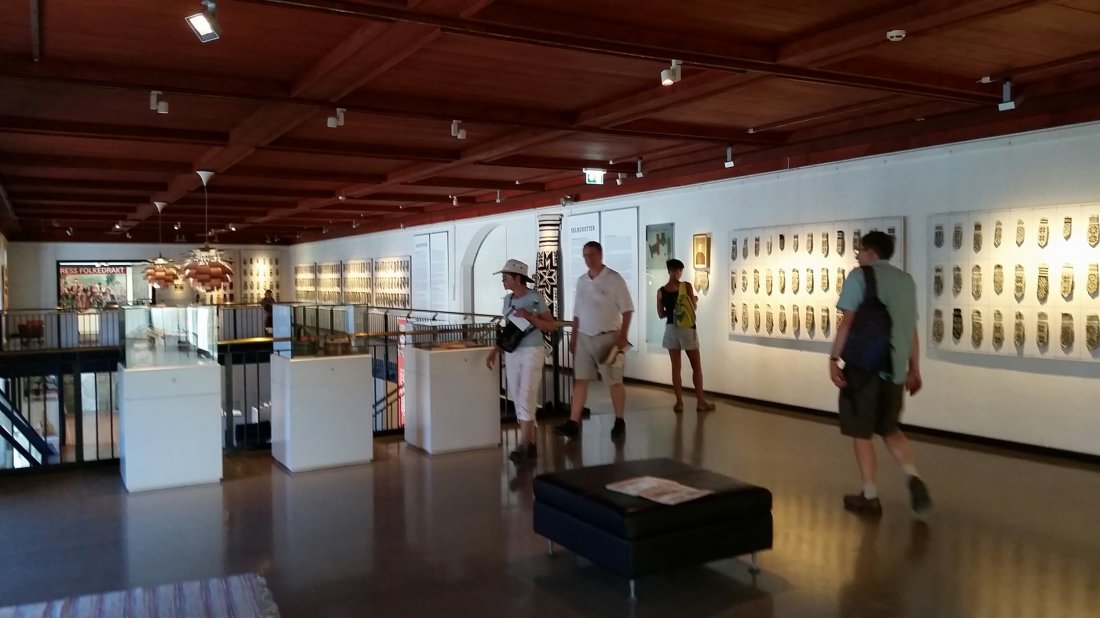
There are more mittens on the walls you can’t see in this picture. Amazingly, the pattern for each mitten on the wall is in a 3 ring binder, which you can see open on the black ottoman in the center off the picture. There were both published and hand charted patterns. Boy, would I like to get a copy of that book! I think they know it might just walk off by itself, so it’s secured to the ottoman. (I looked in the gift shop – no luck.) I have over 80 unique pictures of mittens on the wall, with several mittens in each picture.

I chose just a few to show you here. However, note the cuffs. The cuffs with stranded patterns are traditionally mens mittens. The mittens with lace, ribbing, and/or rings of lines up the cuff are women’s mittens.

Mittens knittted by the “Mother of all mittens”, Marit Emstad, are here. The first stranded black and white mittens can be traced back to her. Previously, mittens were in one color, with designs knitted in different stitch patterns. However, Marit knit the first pair in black and white and wore them to church – a gutsy move on her part. Tradition was very strong. If they were deemed “unacceptable” by the other women at church, it would not go well for her socially. The women at church liked them and started knitting them also. They are often called “Selbu mittens” because Selbu is where she is from.

The yarn she used is much finer sized than what we traditionally use when knitting these type of mittens. The mittens were only showing the front, but I flipped one of them over so you (ok, maybe I, as well) could see both sides. (Yes, I did touch them, shhhhhh). I should have inspected the thumb join to the palm of the hand, but I was in awe and didn’t think of it.

I have hundreds of photos from other exhibits in this museum. I will make some more posts, eventually.

On a more personal note, it rained here for the first time in 3 months a few days ago. Today is a pleasant 80º F, instead of close to (or over) 90º. School has been pretty intense lately. We are cramming two semesters of Norwegian into 6 weeks – a whole years worth. Yikes! Today I took my oral exams for my Norwegian class. I have my written exam on Thursday. Mom, dad, my sister, and uncle will arrive on Thursday and we will travel north to see the family farm, as well as visit other family. I have it on good authority that the family farm raises spelsau sheep! Whoop! I am also hoping to find some spinning wheels and looms there . . .

Hope you har det hyggelig!

The Norwegian Museum of Knitting Industry

I took a 5 day trip to Bergen on the Southern coast of Norway on a bus. We took 1.5 days to get there – stopping for a fjord cruise on the Hardanger Fjord and some other sight seeing. I ended up rooming with a retired school principal from near Edmonds. She was great!
This is the typical picture of Bergen that most people have seen.

Although there was a tour schedule for us in Bergen, I had other things to do. On my list was to visit the Oleana sweater factory, Dale Sweater factory, and the Norwegian Museum of Knitting Industry. Funny thing about Norwegian establishments – their opening days/hours don’t make sense to us Americans. (I have stood in the middle of the road in downtown Oslo on a Friday night at 8:30 pm with it totally silent and no cars on the road. It was spooky.) I could only visit one, so the knitting industry museum it was.

Plenty of people were interested in going with me. However, they had other things they wanted to do first. I was not going to take a chance on that. (Good thing I went then because they got hung up and never made it.) So, off I went to ride the busses in the countryside by myself.

Bergen Museum of Knitting Industry

I sucessfully made it to the transfer station. However, on the second bus the display showing the stops wasn’t working and the lady announcing the stops on the loudspeaker was muffled. The directions were written on the pamphlet in English and sometimes the Norwegian doesn’t translate well. On a hunch, I got off the bus at a stop that was not the one listed in the pamphlet. It was a good thing I did.  I saw a sign for the museum.  However, the next obstacle was the building in the picture on the sign was not evident in any of the surroundings (it is quite a LARGE building, but all I could see were small houses). I found the place after asking a guy who spoke impeccible British english. Once inside, I watched a short movie on a tv in the foyer filmed at the Dale garn factory – showing their dying and color matching process.

I then watched a film about the history of the buiding I was in, told through interviews with former workers. Salhus Tricotagefabric was founded in 1859 and closed in 1989. The Norwegian Museum of Knitting Industry (Norsk Trikotasjemuseet) opened on the premises in 2001. The museum is one of 13 national industrial heritage sites in Norway. It is, basically, a working knitwear factory that is no longer used. All the machines work and are maintained. It’s purpose now is to educate. (You should see the kids program they have – wow!

I was the only one there. Let me reiterate: I was in this HUGE GIGANTIC building, and I was the only visitor there at that time. Yay me!! I got an individualized private tour!! The lady turned on all the machines for me and talked me through each type of machine on each floor. It went all the way from raw wool that was washed, picked, carded, made into pencil roving, spun, plied, dyed, knitted, cut, and sewed. Whew! There were machines of every sort and size you could imagine. It smelled like lanolin and sewing machine oil. One of the interesting things I learned, was after they washed the wool, took the lanolin out of it, and spun it – the single was drawn across a chunk of wax to add moisture back in.  Lanolin was not added in case people had a sensitivity to lanolin. There wasn’t much choice back then about the fabrics you could purchase.


Afterwards, I went to the museum store (of course). There was yarn to buy, made in the factory. There were so many beautiful saturated and tweedy colors. However, I realized that a pile of more yarn that had no specific purpose was not what I needed. However, I wanted something from the museum. So I bought a beautiful pillow pattern kit that included yarn made in the factory. I considered buying a patterned wool sweater made there at the factory. However, they were either too big or too small.

This next weekend, I’m going to Bigdøy and the Museum of Culture and History to look at the knitting and textile exhibits. I think this is where Annemore Sunbø’s collection is. BTW, I did make it out to Spinnvilt last week – Oslo’s spinning and weaving shop. More on that another time, after I visit them again.

Hope your summer is going well.

Ha det!


Museum of Cultural History

*Note: hovering or clicking on seperate photos in montages may bring up descriptions.

One of the nice things about attending the university here is that you get in to almost all the museums in Oslo FREE. In addition, one of the nice things about being in a museum is that they are climate controlled. It has been between 85º and 90º F. There are not a lot of airconditioned buildings in Norway. They are usually trying to keep warm instead of cold. This is the hottest summer they’ve had on record. It’s been 77ºF the last two nights here at 11:30 pm! So . . . museums it is!

There are a lot of museums here. Yesterday, I went to the Museum of Cultural History. The mission of this museum is to “research, manage, and show our shared [world] history”. There were some absolutely amazing exhibits from all over the world. Wendy (one of the other 2 scholarship winners – from Portland) and I started in the Egypt room. We saw several mummys and scarcaphagi. One of the mummys was wrapped in white linen, which was then wrapped in red linen, and then linen straps were wrapped around that.

The threadcount of the linen is amazing – especially when you take into consideration that it was handspun, possibly on some sort of spindle. The white straps are so fine you can’t even see the threads in the photo.

A word about my photos – It is difficult to photograph some of these things. The rooms are dim, because the light can deteriorate the museum pieces. They are behind glass, and the glass, often, is smudged with fingerprints. There are shadows and glare.

I got some pictures of bands woven by a few different cultures. The first ones are from south america. I find it interesting that so many cultures around the world share similar patterns. Wendy didn’t realize that we were looking at South American samples, until I pointed it out. She assumed that because the rose pattern was present that it was from one of the Nordic nations. Notice also the spindle.

Also there were Sami bands. The Sami are a nomadic indigenous people who live in the Arctic Circle and follow the reindeer herds. They are sometimes known as Lapplanders. However, that moniker is politically incorrect.

After seeing the peoples of the world exhibits, we went to look at the Viking age artifacts. The exhibit was limited because they were working on a new one. There were several floors of one wing that were closed. However, here are a few selected photos from the exhibit we did get to see:

20180627_162615-1512073208.jpg
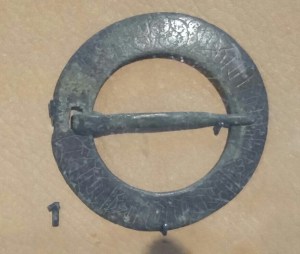
Shawl/dress pins
20180627_162604306696809.jpg
Another shawl pin. Look at the runes written around the circle!


We then went to the Local Husflid. The Husflid is a regional store where you can buy Norwegian regional costumes and the pieces that go with them, as well as some other locally produced folk type goods – Norwegian sweaters, blankets, specialized household goods, etc. It is VERY expensive, but the real deal. We went in to see the bunads (folk dress) for the regions and the jewelery. The bunads are made to order. You don’t just go in there and “pick one up” on the way home from the grocery store. Unfortunately, I can’t share any pictures with you. There is an over $100 American dollar fine for taking pictures of them in the Husflid bunad room. Uh, yeah. Not sure why.

More on another day.

Ha det!

The Viking Ship Museum

Today I got to see 3 ancient viking ships that were used as burial vessels. The Oseburg ship is the one I was most interested in. The Oseburg ship was dug up out of a field in 1904. Inside was found a treasure trove of Viking age textiles.

The ship is dated to the Autumn of 834 and was the burial vessel for 2 women. Their identity is unknown. The bow and stern of the ship are ornately carved. It is the best condition of any of the ships at the museum. 90% of it is the original wood from the ship.

20180624_163919.jpg

20180624_163856.jpg

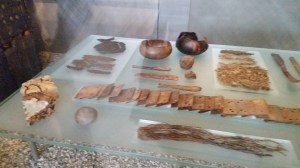
There are textile implements in the general collection. However, I got to visit a room with textile fragments that is forbidden to photograph. They are afraid of degrading the fragments further. In this room, I got to see MANY bands woven with cards, including an unfinished band with warp threads still running through the holes in the cards. There were pieces of a tabby woven wool dress in red and white geometric patterns. The warp was linsey-woolsey and the weft was wool. The linen in the warp had degraded.

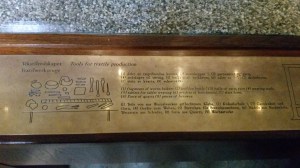
I only was able to view the items in this room for a few minutes. However, I count myself lucky to even have seen them. The pictures in this post show items in the main room that were allowed to be photographed. The brass plaque is the key to the items. I did my best to photograph them, but light was poor and the items were behind glass (of course).

20180624_164751.jpg

20180624_164802.jpg

20180624_164756.jpg

20180624_164859.jpg

20180624_164847.jpg

20180624_164840.jpg

Here I am

I apologiize for the delay in posts. I have had some internet trouble, as well as phone trouble.

My trip to Norway was long and uneventful. Well, ok, almost uneventful. Seattle TSA was murderous to get through – not because of baggage inspection, but because the lines were so long. We switchbacked up and down the terminal several times. There was no standing. It was full speed ahead – with the line moving quickly, at a brisk walk. I was in an area where they were using dogs. They walked up and down the line with a handler before we got to the x-ray machines.

When I finally got to the gate, I had diffficulty buying lunch because all the credit card terminals were not working. I had to go to a restaurant, order food to go, and then take it back to the gate to eat while the rest of the plane was loading.

I slept almost the whole way to Iceland. I woke up for a few moments to glimpse the ice around and over Greenland. It was strange to know some of that ice was over ocean. It was easy to see the difference between the clouds and ice. The clouds were white; the ice was intense white. Little ice crystals formed on the outside window beside my seat.

After a short layover in Reykjavic in Iceland and a little vanilla yogurt, I was back on plane. The yogurt was interesting. Although it was sweet, it was not overly sweet, unlike American yogurt.

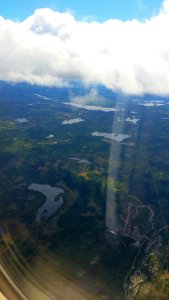
After 2 more hours, trying to crochet a little on the shawl I started (and getting nowhere), I caught my first glimpse of Norway. It’s a lot like where we live.

Family picked me up at the airport.

I’m just about wiped out here. It’s been a busy day.

Ha det!