Adventures in Norwegian Textiles, Travel, and Culture
Author: iduna
I have a PhD in Instructional Design for Online Learning and teach during the day.
However, I spend my free time studying historical textiles, Spinning, Weaving, Knitting, and Crocheting.
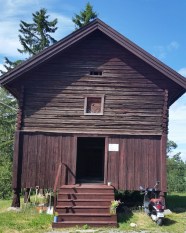
In June, on my second full day staying with family in Norway, we had already seen seen several nearby museums and churches. Of note was Grinaker Vev (Grinaker Loom). This is a small weaving shop and museum out in the countryside in Hadeland, near the town of Brandbu. It has been run for 3 generations by the same family.
They specialize in weaving fabric used to make absolutely “bullet proof” wool work-shirts with small blue stripes (busserulltøy). Although wool, it was not itchy whatsoever. I am kicking myself for not buying a shirt for my son or some of the fabric. However, it was my second day there and I was not quite thinking clearly.
The shop also specializes in weaving fabric for folkdraktor (folk costumes) and bunads (traditional costumes). They are also “one of the few remaining damask weavers in Europe.”
Folkdraktor
Folkdraktor
Christening gown
The business encompasses 3 buildings – the historical building with museum, current weaving building, and a third building with a small cafe and more textiles from the shop. Scattered through the buildings were many looms with projects in process, and finished pieces around.
Original loom – view 1
Original loom – view 2
Original loom – view 3
Work in progress
Work in progress
Work in progress
Work in Progress
It was a treat to visit this museum and shop. My family was very thoughtful when choosing this as one of the special places to show me. The area of Hadeland, where this weaving shop is located is where my Cousin’s wife is from. I was told that, historically, great warriors came from this part of the country. They were particularly brave and skilled. I enjoyed seeing the weaving and hearing the stories. If you would like to see more of Grinakervev textiles, their website can be found at: https://www.grinakervev.no
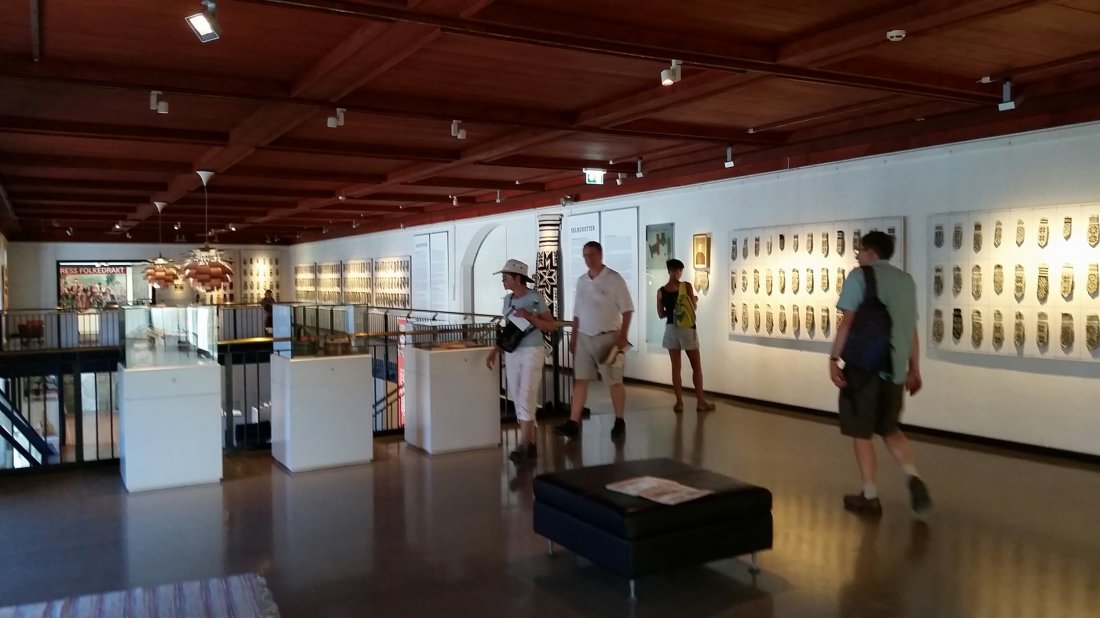
The Norsk Folkemuseum is a giant place with both indoor and outdoor exhibits. We were there for 4 hours and didn’t even see a quarter of it. They have relocated 160 buildings from all over Norway and arranged them into villages – one village for each of the geographical areas of Norway, including a stave church. Besides exhibits inside all the village buildings, there are a couple typical museum buildings housing exhibits. This is where the giant mitten exhibit is. I thought this is were Annemor Sundbø’s mitten collection would be; however it is not.
There are more mittens on the walls you can’t see in this picture. Amazingly, the pattern for each mitten on the wall is in a 3 ring binder, which you can see open on the black ottoman in the center off the picture. There were both published and hand charted patterns. Boy, would I like to get a copy of that book! I think they know it might just walk off by itself, so it’s secured to the ottoman. (I looked in the gift shop – no luck.) I have over 80 unique pictures of mittens on the wall, with several mittens in each picture.
I chose just a few to show you here. However, note the cuffs. The cuffs with stranded patterns are traditionally mens mittens. The mittens with lace, ribbing, and/or rings of lines up the cuff are women’s mittens.
Mittens knittted by the “Mother of all mittens”, Marit Emstad, are here. The first stranded black and white mittens can be traced back to her. Previously, mittens were in one color, with designs knitted in different stitch patterns. However, Marit knit the first pair in black and white and wore them to church – a gutsy move on her part. Tradition was very strong. If they were deemed “unacceptable” by the other women at church, it would not go well for her socially. The women at church liked them and started knitting them also. They are often called “Selbu mittens” because Selbu is where she is from.
The yarn she used is much finer sized than what we traditionally use when knitting these type of mittens. The mittens were only showing the front, but I flipped one of them over so you (ok, maybe I, as well) could see both sides. (Yes, I did touch them, shhhhhh). I should have inspected the thumb join to the palm of the hand, but I was in awe and didn’t think of it.
I have hundreds of photos from other exhibits in this museum. I will make some more posts, eventually.
On a more personal note, it rained here for the first time in 3 months a few days ago. Today is a pleasant 80º F, instead of close to (or over) 90º. School has been pretty intense lately. We are cramming two semesters of Norwegian into 6 weeks – a whole years worth. Yikes! Today I took my oral exams for my Norwegian class. I have my written exam on Thursday. Mom, dad, my sister, and uncle will arrive on Thursday and we will travel north to see the family farm, as well as visit other family. I have it on good authority that the family farm raises spelsau sheep! Whoop! I am also hoping to find some spinning wheels and looms there . . .
I took a 5 day trip to Bergen on the Southern coast of Norway on a bus. We took 1.5 days to get there – stopping for a fjord cruise on the Hardanger Fjord and some other sight seeing. I ended up rooming with a retired school principal from near Edmonds. She was great!
This is the typical picture of Bergen that most people have seen.
Although there was a tour schedule for us in Bergen, I had other things to do. On my list was to visit the Oleana sweater factory, Dale Sweater factory, and the Norwegian Museum of Knitting Industry. Funny thing about Norwegian establishments – their opening days/hours don’t make sense to us Americans. (I have stood in the middle of the road in downtown Oslo on a Friday night at 8:30 pm with it totally silent and no cars on the road. It was spooky.) I could only visit one, so the knitting industry museum it was.
Plenty of people were interested in going with me. However, they had other things they wanted to do first. I was not going to take a chance on that. (Good thing I went then because they got hung up and never made it.) So, off I went to ride the busses in the countryside by myself.
Bergen Museum of Knitting Industry
I sucessfully made it to the transfer station. However, on the second bus the display showing the stops wasn’t working and the lady announcing the stops on the loudspeaker was muffled. The directions were written on the pamphlet in English and sometimes the Norwegian doesn’t translate well. On a hunch, I got off the bus at a stop that was not the one listed in the pamphlet. It was a good thing I did. I saw a sign for the museum. However, the next obstacle was the building in the picture on the sign was not evident in any of the surroundings (it is quite a LARGE building, but all I could see were small houses). I found the place after asking a guy who spoke impeccible British english. Once inside, I watched a short movie on a tv in the foyer filmed at the Dale garn factory – showing their dying and color matching process.
I then watched a film about the history of the buiding I was in, told through interviews with former workers. Salhus Tricotagefabric was founded in 1859 and closed in 1989. The Norwegian Museum of Knitting Industry (Norsk Trikotasjemuseet) opened on the premises in 2001. The museum is one of 13 national industrial heritage sites in Norway. It is, basically, a working knitwear factory that is no longer used. All the machines work and are maintained. It’s purpose now is to educate. (You should see the kids program they have – wow!
I was the only one there. Let me reiterate: I was in this HUGE GIGANTIC building, and I was the only visitor there at that time. Yay me!! I got an individualized private tour!! The lady turned on all the machines for me and talked me through each type of machine on each floor. It went all the way from raw wool that was washed, picked, carded, made into pencil roving, spun, plied, dyed, knitted, cut, and sewed. Whew! There were machines of every sort and size you could imagine. It smelled like lanolin and sewing machine oil. One of the interesting things I learned, was after they washed the wool, took the lanolin out of it, and spun it – the single was drawn across a chunk of wax to add moisture back in. Lanolin was not added in case people had a sensitivity to lanolin. There wasn’t much choice back then about the fabrics you could purchase.
The big daddy drumcarder
Spinning
Plying
The sewing floor
Afterwards, I went to the museum store (of course). There was yarn to buy, made in the factory. There were so many beautiful saturated and tweedy colors. However, I realized that a pile of more yarn that had no specific purpose was not what I needed. However, I wanted something from the museum. So I bought a beautiful pillow pattern kit that included yarn made in the factory. I considered buying a patterned wool sweater made there at the factory. However, they were either too big or too small.
This next weekend, I’m going to Bigdøy and the Museum of Culture and History to look at the knitting and textile exhibits. I think this is where Annemore Sunbø’s collection is. BTW, I did make it out to Spinnvilt last week – Oslo’s spinning and weaving shop. More on that another time, after I visit them again.
The International Summer School at University of Oslo is packed full of extracurricular activities. Truth be told, I could fill my days with fun things to do, sponsored by the University, and not study a darned bit. This is compounded by the whole “midnight sun” phenomenon. At 11:30 pm it is just starting to get dusk. I’m not sure it really ever gets dark. I haven’t tried staying up to see. However, I have woken up at 4 am a few times and it is bright as day out.
Included in the summer school tuition is an overnight excursion to one of several places. I chose to go to Telemark. I wanted to see the Heddal Stave Church and wild reindeer. It ended up being way better than I ever could imagine.
We got on a bus and headed to the Telemark region of Norway.
Our first stop was at the Heddal stave church – the largest remaining stave church in Norway. Stave churches are wooden churches from the middle ages. They are named such because of the “staves” or support columns that support the church. This stave church dates from around 1150 and is still in use every Sunday for church services. The inside of this church is painted richly and the outside has carved portals. Hidden in the carvings are pagan symbols relating to the old Norse Pantheon of gods.
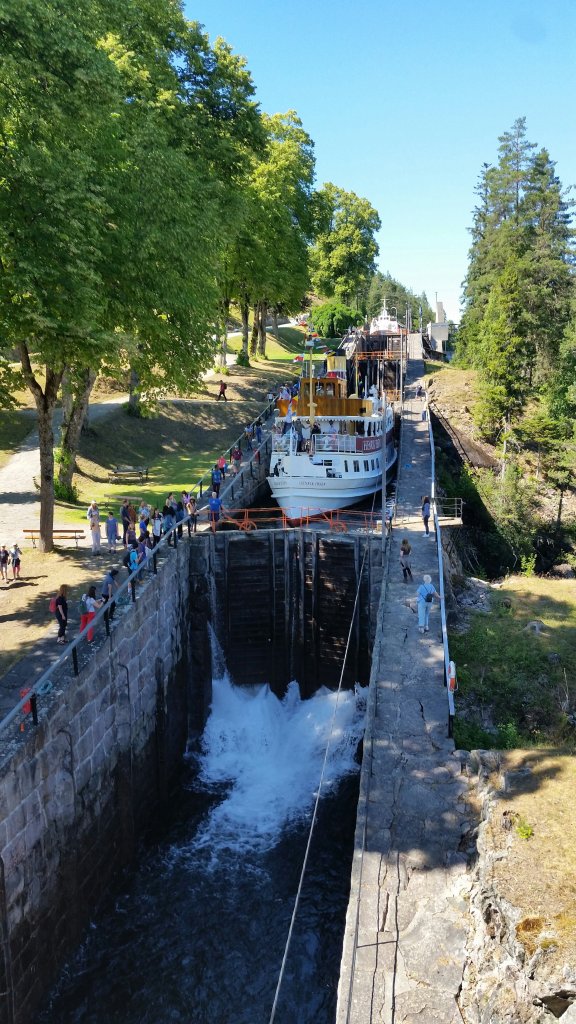
Next we headed to the Vrangfoss Locks. Yeah, no biggie, I thought. I’ve seen the locks in Seattle many times. However, I found these are a *bit* different than the locks I am used to. The Vranfoss Locks are on the Telemark canal. The canal was finished in 1892. Five hundred men worked for five years to clear a route to Skein to the village in Dalen. It was a canal that connected east and west Norway so it was not needed to sail around the bottom of the country to transport goods. There are a total of 18 lock chambers on the canal. Vrangfoss has 5 of them. Here’s the kicker – they are still in full service with the original equipment and wood gates and are RUN BY HAND! Men run back and forth between the chambers and open/shut portions of the gates as needed. It was quite amazing. I had intended to video the boats moving down the locks. However, I realized that holding paper in one hand, recording with the other and trying to narrate it all in Norwegian at the same time, without dropping the phone or falling in myself, was probably a bad idea.
Next was the biggest surprise of all. We headed off in our bus again to Natadal, the place we were going to sleep at night. Boy were we in for a surprise. We were sleeping at an old old old farm from the 1400’s that had been made into a bed and breakfast, while still keeping the integrity of the farm – including raising animals and growing their food. We learned about traditional Norwegian farms – the buildings and the workings.
We pulled up to a thatch roofed set of buildings on the side of a valley. As we got off the bus, the man told us to put our things in our rooms, get a towel from the cabinet in the hallway, and follow the trail for swimming. Ok, well actually, he said to follow the trail to “Miami Beach”. At the end of the trail through beautiful flower -filled meadows, there was a small (but very deep) mountain lake – more like a swimming hole. The water was surprisingly warm. (I suppose warm is what you get when it’s between 80º & 90º F for a month or more). We had elk stew for dinner (okay, I can’t eat elk, but everyone else was impressed with it.) For dessert, we had custard with caramel sauce made from the eggs of the chickens on the farm, topped with chopped hazelnuts from the hazelnut trees on the farm. We all said we wished we could stay and should have come to the farm right away instead of making the stops on the way to the farm. The next day we got back in the bus to head home – after visiting two more places.
The place we stopped first was Hardangervidda National Park Center. This is one of Europe’s largest national parks and one of Norway’s largest glaciers is situated in this park. It has an alpine climate and many arctic animals and plants live there. We took a hike and learned about the conservation research they are doing there with reindeer and the environment. I had hoped to see some, but they had headed up farther where it was colder. It’s been too hot for them. We also learned about the role the park played in sabotaging the Germans in WW2, but that is a story too long to tell here.
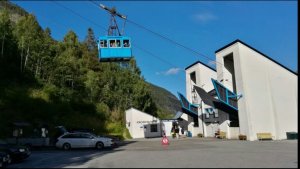
Lastly we took a ride on the cable car Krossobanen. This cable car to the top of the mountain ridge above the town of Rjukan was a gift to the people there by Norsk Hydro many years ago so that the people of the valley could be in the sun during winter months. The sun never falls on the town in the winter because the mountains that surround them are too high and the sun never rises high enough to clear the mountain tops. Now the town has a giant sun mirror that reflects 600 square meters of sun into the town center during the winter, so they can see sunlight.
When we got home, I was exhausted. I woke up in the morning to find I had thrown my socks in the garbage can instead of in the dirty clothes hamper!
*Note: hovering or clicking on seperate photos in montages may bring up descriptions.
One of the nice things about attending the university here is that you get in to almost all the museums in Oslo FREE. In addition, one of the nice things about being in a museum is that they are climate controlled. It has been between 85º and 90º F. There are not a lot of airconditioned buildings in Norway. They are usually trying to keep warm instead of cold. This is the hottest summer they’ve had on record. It’s been 77ºF the last two nights here at 11:30 pm! So . . . museums it is!
There are a lot of museums here. Yesterday, I went to the Museum of Cultural History. The mission of this museum is to “research, manage, and show our shared [world] history”. There were some absolutely amazing exhibits from all over the world. Wendy (one of the other 2 scholarship winners – from Portland) and I started in the Egypt room. We saw several mummys and scarcaphagi. One of the mummys was wrapped in white linen, which was then wrapped in red linen, and then linen straps were wrapped around that.
closer look at mummy
The threadcount of the linen is amazing – especially when you take into consideration that it was handspun, possibly on some sort of spindle. The white straps are so fine you can’t even see the threads in the photo.
A word about my photos – It is difficult to photograph some of these things. The rooms are dim, because the light can deteriorate the museum pieces. They are behind glass, and the glass, often, is smudged with fingerprints. There are shadows and glare.
I got some pictures of bands woven by a few different cultures. The first ones are from south america. I find it interesting that so many cultures around the world share similar patterns. Wendy didn’t realize that we were looking at South American samples, until I pointed it out. She assumed that because the rose pattern was present that it was from one of the Nordic nations. Notice also the spindle.
South American
South American
South American
South American
Also there were Sami bands. The Sami are a nomadic indigenous people who live in the Arctic Circle and follow the reindeer herds. They are sometimes known as Lapplanders. However, that moniker is politically incorrect.
Sami
Sami
Sami woven belts
Sami
After seeing the peoples of the world exhibits, we went to look at the Viking age artifacts. The exhibit was limited because they were working on a new one. There were several floors of one wing that were closed. However, here are a few selected photos from the exhibit we did get to see:
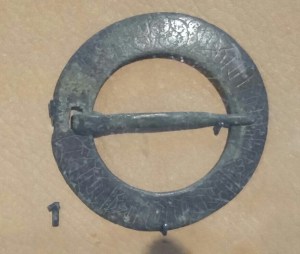
Shawl/dress pins
Another shawl pin. Look at the runes written around the circle!
Twill woven cloth. Plain weave was most common.
Buttons – cut out with a stamp or turned. Comb
Spindle hook on distaff (hook is missing)
Detail of sword-beater
Loom weights (made of soapstone) and sword-beater. Looms were upright.
Tools: scissors, needles, and nålbinding needles
We then went to the Local Husflid. The Husflid is a regional store where you can buy Norwegian regional costumes and the pieces that go with them, as well as some other locally produced folk type goods – Norwegian sweaters, blankets, specialized household goods, etc. It is VERY expensive, but the real deal. We went in to see the bunads (folk dress) for the regions and the jewelery. The bunads are made to order. You don’t just go in there and “pick one up” on the way home from the grocery store. Unfortunately, I can’t share any pictures with you. There is an over $100 American dollar fine for taking pictures of them in the Husflid bunad room. Uh, yeah. Not sure why.
Today I got to see 3 ancient viking ships that were used as burial vessels. The Oseburg ship is the one I was most interested in. The Oseburg ship was dug up out of a field in 1904. Inside was found a treasure trove of Viking age textiles.
The ship is dated to the Autumn of 834 and was the burial vessel for 2 women. Their identity is unknown. The bow and stern of the ship are ornately carved. It is the best condition of any of the ships at the museum. 90% of it is the original wood from the ship.
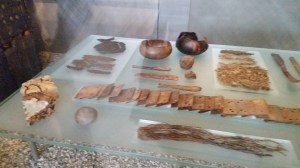
There are textile implements in the general collection. However, I got to visit a room with textile fragments that is forbidden to photograph. They are afraid of degrading the fragments further. In this room, I got to see MANY bands woven with cards, including an unfinished band with warp threads still running through the holes in the cards. There were pieces of a tabby woven wool dress in red and white geometric patterns. The warp was linsey-woolsey and the weft was wool. The linen in the warp had degraded.
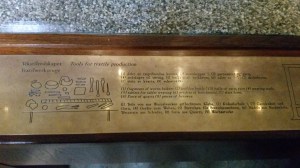
I only was able to view the items in this room for a few minutes. However, I count myself lucky to even have seen them. The pictures in this post show items in the main room that were allowed to be photographed. The brass plaque is the key to the items. I did my best to photograph them, but light was poor and the items were behind glass (of course).
I apologiize for the delay in posts. I have had some internet trouble, as well as phone trouble.
My trip to Norway was long and uneventful. Well, ok, almost uneventful. Seattle TSA was murderous to get through – not because of baggage inspection, but because the lines were so long. We switchbacked up and down the terminal several times. There was no standing. It was full speed ahead – with the line moving quickly, at a brisk walk. I was in an area where they were using dogs. They walked up and down the line with a handler before we got to the x-ray machines.
When I finally got to the gate, I had diffficulty buying lunch because all the credit card terminals were not working. I had to go to a restaurant, order food to go, and then take it back to the gate to eat while the rest of the plane was loading.
I slept almost the whole way to Iceland. I woke up for a few moments to glimpse the ice around and over Greenland. It was strange to know some of that ice was over ocean. It was easy to see the difference between the clouds and ice. The clouds were white; the ice was intense white. Little ice crystals formed on the outside window beside my seat.
After a short layover in Reykjavic in Iceland and a little vanilla yogurt, I was back on plane. The yogurt was interesting. Although it was sweet, it was not overly sweet, unlike American yogurt.
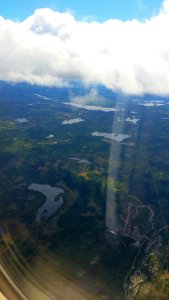
After 2 more hours, trying to crochet a little on the shawl I started (and getting nowhere), I caught my first glimpse of Norway. It’s a lot like where we live.
Family picked me up at the airport.
I’m just about wiped out here. It’s been a busy day.
This spring I received the Saltveit scholarship from the Sons of Norway. It includes tuition, room, and board at Oslo University in Norway. Through the summer I will be studying Norwegian language in Norway, while my family stays in the United States.
In addition to studying language, I will get to explore and learn about Norwegian fiber arts: spinning, weaving, knitting, and the like. I am most excited to be learning language skills that will further my learning by being able to consult primary sources in Norwegian.
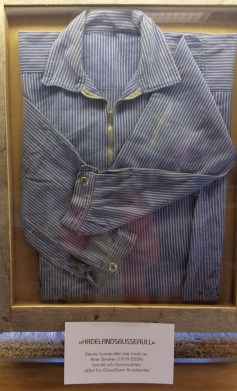 They specialize in weaving fabric used to make absolutely “bullet proof” wool work-shirts with small blue stripes (busserulltøy). Although wool, it was not itchy whatsoever. I am kicking myself for not buying a shirt for my son or some of the fabric. However, it was my second day there and I was not quite thinking clearly.













 As the Whorl Turns